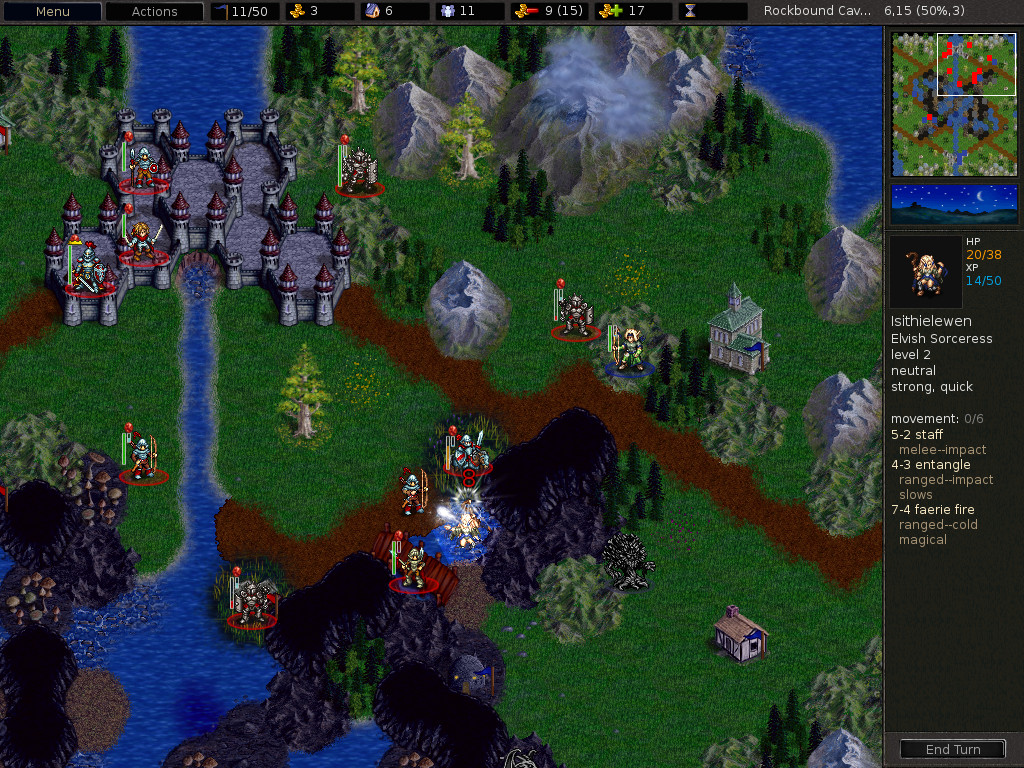
 ...is a "minute-to-learn" style strategy game that is a great deal of fun, and free! There are versions for Windows, Linux, and Mac. Link.
The Stars, Our Destination...
Saturday, March 24, 2007
Battle for Wesnoth...
...is a "minute-to-learn" style strategy game that is a great deal of fun, and free! There are versions for Windows, Linux, and Mac. Link.

Tuesday, March 20, 2007

Standing room only
On Sunday, I was on Long Island for a meeting, and went to Queens afterwards for Indian food. Along the way, I saw an stunningly crowded graveyard, called the Mount Zion cemetery. It has been noted by art historians that in proportion and density, these gravestones resemble the surrounding city.
 This is not my photo. It is from Flickr. (Link.)
This is not my photo. It is from Flickr. (Link.)
Saturday, March 17, 2007
Doom!
"Total US wheat production has dropped from 58.74 million metric tons in 2004 to a projected 49.32 in March of 2007. That's a drop of 16%. Over the same period (2004 to Match 2007's yearly projection) all European countries have decreased wheat production as well. Australia -- which has been hit by a drought -- has seen production drop from 22.60 to 10.5 million metric tons. Overall world production has dropped from 628.59 million metric tons in 2004 to 593.11 million metric tons -- a decrease of 5.62%."
Sunday, March 11, 2007
Dreams That Money Can Buy
"Here's something you on which you can really pride yourself. You've discovered you can look inside yourself. You know what that means? You're promoted. You're no longer a bum. You're an artist." This 1947 film by Hans Richter, who is most famous for "Ghosts Before Breakfast" (link), is available from Google Video in its entirety (link). The film is a collection of segments made in collaboration with the following artists: Max Ernst, Fernand Leger, Marcel Duchamp and Alexander Calder.
 This 1947 film by Hans Richter, who is most famous for "Ghosts Before Breakfast" (link), is available from Google Video in its entirety (link). The film is a collection of segments made in collaboration with the following artists: Max Ernst, Fernand Leger, Marcel Duchamp and Alexander Calder.
Mind mapping software
In my free time over the past week, I've been scouring the web and Linux repositories for a program that can draw concept maps and mind maps quickly and clearly. Both structures are radial, hierarchical lists, the difference is that a mind map radiates from one center, whereas a concept map includes multiple core concepts. This makes mind mapping more suitable for brainstorming, while concept mapping can better represent inter-relationships. I found three very different freeware programs that are suited to this task: Dia, Mindraider, and Freemind. All three are cross-platform (and free, ed.).
Dia is a general flow charting program and probably gives the most flexibility of the three programs. Unfortunately, it lacks the speed of input that brainstorming requires. Dia come with a package for making UML (Unified Modeling Language) figures; a software engineering process diagramming standard. A cursory look shows that no one has converted the great works of literature and philosophy into UML, which is an unmet need if we expect our robots to be at all educated.
Mindraider utilizes a super-cool visualization that you'll be familiar with if you've ever visited the Visual Thesaurus. It presents your map in two ways simultaneously, as a list and a tree, with a third pane open for metadata (exposition on a particular item, as well as web URLs and links to local resources). Mindraider integrates with Gnowsis, which is part of a class of programs that describe themselves as semantic desktops. The idea is to map the user's files into a flowchart along with things that might not be properly represented in the file system, such as projects, contacts and locales. I'm suspicious of the usefulness of this, because if you have two organizational structures for your file system, you'll get a lot of cross-talk and will probably end up with neither system being organized. Still, programs like DeepaMehta look snazzy, even if they don't end up being more than well designed widgets.
Freemind recently updated to its beta version nine, adding some very useful functions. It is the only program of the three that includes an embedded scheduler, which is useful when mapping projects and task dependencies. It includes includes image support, unlike Mindaider, and collapsible nodes and fast input, unlike Dia. Freemind can also export its mind maps to web pages via an embedded java engine. There are two similar programs for the Gnome-desktop: KDissert and VYM (View Your Mind) that are certainly well-made, but not as feature-rich.
Dia is a general flow charting program and probably gives the most flexibility of the three programs. Unfortunately, it lacks the speed of input that brainstorming requires. Dia come with a package for making UML (Unified Modeling Language) figures; a software engineering process diagramming standard. A cursory look shows that no one has converted the great works of literature and philosophy into UML, which is an unmet need if we expect our robots to be at all educated.
Mindraider utilizes a super-cool visualization that you'll be familiar with if you've ever visited the Visual Thesaurus. It presents your map in two ways simultaneously, as a list and a tree, with a third pane open for metadata (exposition on a particular item, as well as web URLs and links to local resources). Mindraider integrates with Gnowsis, which is part of a class of programs that describe themselves as semantic desktops. The idea is to map the user's files into a flowchart along with things that might not be properly represented in the file system, such as projects, contacts and locales. I'm suspicious of the usefulness of this, because if you have two organizational structures for your file system, you'll get a lot of cross-talk and will probably end up with neither system being organized. Still, programs like DeepaMehta look snazzy, even if they don't end up being more than well designed widgets.
Freemind recently updated to its beta version nine, adding some very useful functions. It is the only program of the three that includes an embedded scheduler, which is useful when mapping projects and task dependencies. It includes includes image support, unlike Mindaider, and collapsible nodes and fast input, unlike Dia. Freemind can also export its mind maps to web pages via an embedded java engine. There are two similar programs for the Gnome-desktop: KDissert and VYM (View Your Mind) that are certainly well-made, but not as feature-rich.
Wednesday, March 07, 2007
Interviews from the Edge...
 Some of my favorite science fiction literature comes in the form of conspiracy lore I've stumbled across while browsing the InterWeb(TM) during the last decade or so. Here are a few of my top-picks: An interview with a guy who was a security guard at a secret underground alien lab in which, despite our best efforts, UFO aliens are doing everything in their power to act like barbaric space-Nazis. Another interview, this time with Lacerta, a subterranean dwelling lizard woman who has a thing or two to say about how stupid humans are. Also, don't pass up the thrilling story of John Titor: Libertarian Time Explorer...
...and always remember:
"There is no fraternizing with the aliens off hours."
Saturday, February 24, 2007
MAN VERSUS MACHINE

This guy commented on my last rant about DRM and Apple.
I just need to point out that the diagrams that he provides on his tutorials are pure art.
Away From Keyboard.


I imagine that this will be my last post for some time as I am departing for a tour of Southeast Asia. The planned itinerary will take me and some wacky German backpackers to Cambodia, Laos, and Myanmar (Burma) with travel stops in Qatar and Bangkok. I have a keen art history interest to take in the temples of Angkor in Cambodia. Angkor Wat (pictured above) is the largest religious building standing on the entire planet.
If anyone has thought to install cyber-terminals in the jungle I will check in and maybe do some travel blogging.
If anyone is interested in information about my destinations, check out the CIA World Factbook. This is a great place for a neutral perspective on Southeast Asia . . . err . . . or maybe not.
Count the Ways That Steve Jobs Loves You:
Digital Locks Galore!
Recently, I have been meeting more Americans that are passing through Berlin. This has coincided with more instances of me hearing about a device called the iPod.
For future reference, spending time getting an earful about what bands you have on your shiny new portable- overpriced- industrial- design- wonder- 8-track-player at the very least bores me to tears, and I will avoid commenting on attempts to start such a conversation like a bad rash. I am consistently amazed at how this marketing phenomenon has tapped into the concept of identity for a very large group of consumers, and frankly this fetishism irritates me.
A guy from BoingBoing has written a very good article for Salon laying out the many ways that "Digital Rights Management" software locks are bad for the distribution of digital media and how Steve Jobs continues to be pleased to have these written into every product he sells.
"If you rip your own CDs and load them onto your iPod, you'll notice something curious. The iPod is a roach motel: Songs check in, but they don't check out. Once you put music on your iPod, you can't get it off again with Apple's software. No recovering your music collection off your iPod if your hard drive crashes. What's more, Apple prevents copying indiscriminately. You can't copy any music off your iPod. Apple even applies the no-copying measure to audio released under a Creative Commons license . . . which prohibits adding DRM."
"At the end of the day, DRM is the biggest impediment to a legitimate music market. Apple doesn't sell music because of DRM -- it sells music in spite of DRM. The iTunes Store proves that you can compete with free. People have bought billions of dollars worth of music from Apple because it offered a better user experience. But no one bought for the DRM. Some people bought in spite of it, some bought in ignorance of it, but there's no customer for whom DRM is a selling point. No one woke up this morning wishing for a way to do less with her music."
"A weird little no-name from the wildly imaginative entrepreneurs of Malaysia" sounds like a much better set up to me, especially considering it costs ten percent of the price. But I do not walk around drowning out the world with pop music 24 hours a day either, so I guess the point is moot. I wonder if this makes people feel invincible and smooth like Shaft as they have catchy theme music available for even the most mundane of tasks . . .
For future reference, spending time getting an earful about what bands you have on your shiny new portable- overpriced- industrial- design- wonder- 8-track-player at the very least bores me to tears, and I will avoid commenting on attempts to start such a conversation like a bad rash. I am consistently amazed at how this marketing phenomenon has tapped into the concept of identity for a very large group of consumers, and frankly this fetishism irritates me.
A guy from BoingBoing has written a very good article for Salon laying out the many ways that "Digital Rights Management" software locks are bad for the distribution of digital media and how Steve Jobs continues to be pleased to have these written into every product he sells.
"If you rip your own CDs and load them onto your iPod, you'll notice something curious. The iPod is a roach motel: Songs check in, but they don't check out. Once you put music on your iPod, you can't get it off again with Apple's software. No recovering your music collection off your iPod if your hard drive crashes. What's more, Apple prevents copying indiscriminately. You can't copy any music off your iPod. Apple even applies the no-copying measure to audio released under a Creative Commons license . . . which prohibits adding DRM."
"At the end of the day, DRM is the biggest impediment to a legitimate music market. Apple doesn't sell music because of DRM -- it sells music in spite of DRM. The iTunes Store proves that you can compete with free. People have bought billions of dollars worth of music from Apple because it offered a better user experience. But no one bought for the DRM. Some people bought in spite of it, some bought in ignorance of it, but there's no customer for whom DRM is a selling point. No one woke up this morning wishing for a way to do less with her music."
"A weird little no-name from the wildly imaginative entrepreneurs of Malaysia" sounds like a much better set up to me, especially considering it costs ten percent of the price. But I do not walk around drowning out the world with pop music 24 hours a day either, so I guess the point is moot. I wonder if this makes people feel invincible and smooth like Shaft as they have catchy theme music available for even the most mundane of tasks . . .
Subscribe to:
Posts (Atom)